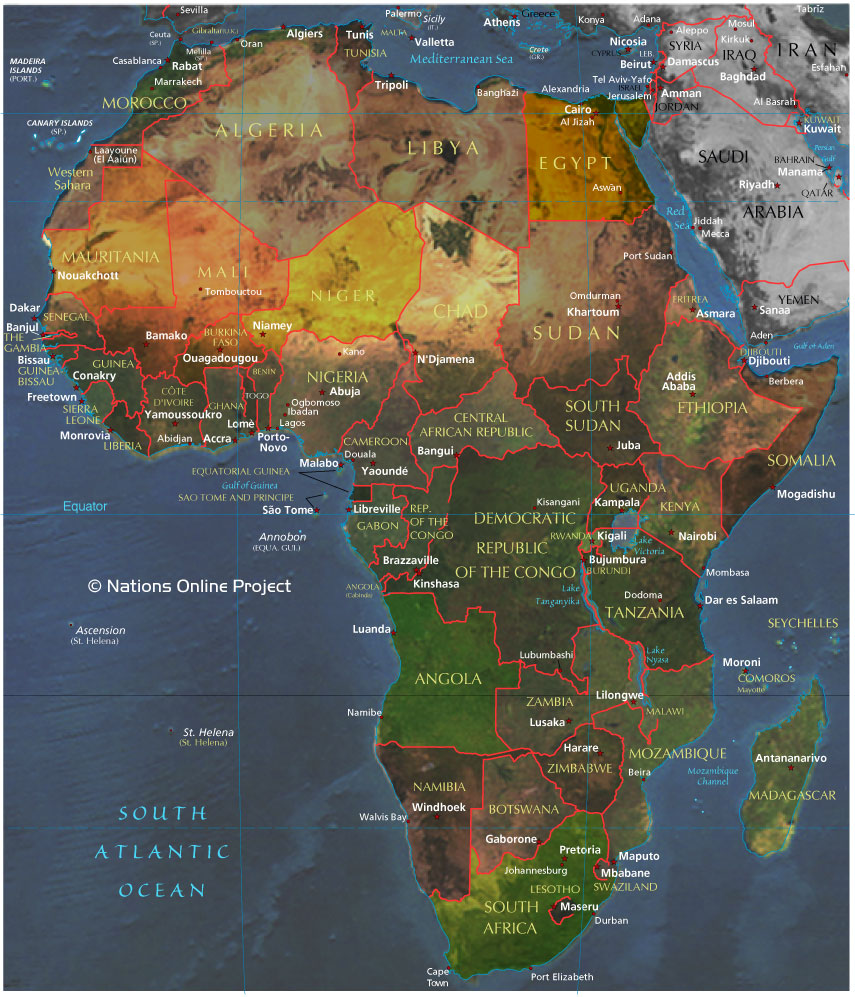
This is the current African political map, click here...
Saturday, 19 November 2016

Thursday, 3 November 2016
Global Dialogue on Water Security and Sustainable Growth
Tips on Global water resources click water...
Monday, 31 October 2016
Saturday, 22 October 2016
GPA COUNTS?
By: Gorwe J. Waryoba
 Grade Points Average
(GPA), is the average points grade acquired by a learner at a given time of
completion of a certain course of study: especially, in collages and
Universities. Where, there are different grading systems according to different
collages and / or Universities. For example, 4.4 – 5.0 GPA (70 - 100% Marks = A)
is termed as First class; 3.5 – 4.3 GPA (60 – 69% Marks = B+), is termed as the
Second Class Upper; 2.7 - 3.4 GPA (50 – 59% Marks = B), is termed as the Second
Class Lower, and 2.0 – 2.6 GPA (40 – 49% Marks = C), is termed as Pass (Third
Class): according to Tanzania grading system. However, SAUT grades differently
in terms of ‘marks’, whereby, the same GPA’s marks are graded as follow: 80 – 100%
= A, 70 – 79% = B+, 60 – 69% = B, and 50
– 59% = C.
Grade Points Average
(GPA), is the average points grade acquired by a learner at a given time of
completion of a certain course of study: especially, in collages and
Universities. Where, there are different grading systems according to different
collages and / or Universities. For example, 4.4 – 5.0 GPA (70 - 100% Marks = A)
is termed as First class; 3.5 – 4.3 GPA (60 – 69% Marks = B+), is termed as the
Second Class Upper; 2.7 - 3.4 GPA (50 – 59% Marks = B), is termed as the Second
Class Lower, and 2.0 – 2.6 GPA (40 – 49% Marks = C), is termed as Pass (Third
Class): according to Tanzania grading system. However, SAUT grades differently
in terms of ‘marks’, whereby, the same GPA’s marks are graded as follow: 80 – 100%
= A, 70 – 79% = B+, 60 – 69% = B, and 50
– 59% = C.
The Ministry of
Education, Science and Vocational Training (MESVT), of Tanzania, through
Tanzania Commission for Universities (TCU): has currently put it clear, that
for one to join undergraduate degree, from a diploma level on any other
qualification; must have a minimum of 3.0 GPA. Thus, those who are under 3.0
GPA, will not excel their academic to the higher level (degree) in Tanzania.
When it comes to further
studies: different Universities have their criteria on the minimum
qualification of entry to certain degree programme. For example, in order to
pursue a certain master degree in the University of Dar es Salaam: one must have
a minimum of 3.5 GPA in his/her respective bachelor degree. Currently, in St.
Augustine University of Tanzania (SAUT), one has to be with a GPA of at least
2.7 in order to join a given master degree, and at least a GPA of 3.0 to join a
PhD as opposed to the previous criteria of 3.5 GPA. Hence, GPA counts.
Employments in
different institutions, such as Higher learning institutions: Colleges and
Universities needs and a certain minimum GPA qualification for one to be
employed in that institution. For example, most of them needs one to have 3.8
GPA 4.0 GPA and above. Thus, GPA counts in acquiring a job in these institutions.
When it comes to
leadership, and positions in the St. Augustine Universities of Tanzania
Students’ Organisation (SAUTSO); GPA counts. Since, one cannot compete or fill
on President’s position, and / or Members of Parliament (MP) from Second years
(or third years for those whose programme takes four years), and the Ministers
in respective ministries: if one does not have a minimum of 3.5 GPA. Thus, GPA
counts in here.
Still, there have been
rumours in the country, that the government will be employing only people with
the minimum qualification of 3.5 GPA starting this government year 2016/2017;
especially, in education sector: secondary schools. However, there is no
official announcement by the government of Tanzania.
However, some institutions
discourage hiring experts with high GPA like first class: since they say, that
those experts with highest GPA, are expensive, and proud of their qualification
rather than using their knowledge and skills for the company’s betterment. Thus,
they prefer workers whose GPA are at average level, as far as they are
concerned.
They argue that GPA doesn’t count when it comes to competence at
work. There are lot of graduates with high GPA whom have low performance in
their work. They are incapable of applying the knowledge their have acquired.
Mbiti (2007:5), argues that: “paper qualification without proper work attitudes
cannot yield much. Efficiency of work is a combination of both skills and
proper attitudes where employees are concerned”.
All in all, GPA matters
in many things and fields. Therefore, when you get an opportunity to study a
certain programme, in any level of education: try your best to acquire high
marks as much as you can, since GPA counts in many field, no matter what. It’s
my hope that everyone in the campus should do his or her best to earn a good
GPA in that respective programme. God bless you.
Contact:
http://gorwewm.blogspot.com
https://mytanzaniatoday.blogspo.com
Tuesday, 18 October 2016
SAUT: STOP COMPLAINING, LET US STUDY
By: Gorwe J. Waryoba
 Let me start this
discussion by citing some quotations from different scholars on education. Mandela argues that, “Education is the most
powerful weapon which you can use to change the World”. However, Aristotle
states that, “The roots of education are bitter, but the fruits are sweet”. Its
high time now, to start afresh with a new spirit, new power, new courage, and
new mindset towards study, in this year of study 2016/2017.
Let me start this
discussion by citing some quotations from different scholars on education. Mandela argues that, “Education is the most
powerful weapon which you can use to change the World”. However, Aristotle
states that, “The roots of education are bitter, but the fruits are sweet”. Its
high time now, to start afresh with a new spirit, new power, new courage, and
new mindset towards study, in this year of study 2016/2017.
As far as I am
concerned, as a student at St. Augustine University of Tanzania (SAUT) for the
third year now; even before joining the University: there had have been a lot of
complaints and talks on the number of courses offered and the fixed time table
at SAUT. Some students complain, that there are so many courses; which are so
much involved at a short period of time. They lament that, when you enter into
the campus, you become too busy, no time to rest.
Then, I wonder!
When I hear, even the secondary school pupils,
who have not yet even entered in any University: hearing them discussing on the matter, just by
“only hear sayings” from some of SAUT
students on the street. Hence, when some choose and/ or selected to SAUT: as the
first year students, they start following the same beat (complaining), which
they had have been heard on the SAUT academic matters: even before starting their
study.
However, there are good
news that I am told by different people and I always here from different
industries, and the streets I pass through all over the country about the high proficiency
of graduates from the SAUT: in their field of study. If I can sight an example,
in the field of education, which I am in; when we do go to the “field practice” in
different schools, we meet with various student teachers from different
Universities: student teachers from SAUT do the best, as far as academic
matters are concerned. If I try to make my reflections on all the happenings, I
thank God for the opportunity that I got to be selected to study at SAUT.
Therefore, I would like
to urge you, SAUT students; study hard and not to complain about the number of courses
and the fixed time table that we have in our University. These are the things
which make us the best in our specialisations, and help us be useful, and
marketable Worldwide; in different industries and the society at large. The
nature of the University mould us to be
multipurpose, and self – reliants in our
lives. “Stop complaining let us study”.
Contact:
gorwewm@gmail.com
Friday, 14 October 2016
MWL. NYERERE: THE FATHER OF TANZANIA
Julius Nyerere 1922–1999
Former president of Tanzania
At a Glance…
Architect of Independence
President of the Republic
President of Tanzania
Ujamaa
His Legacy
Selected writings
Sources
When he stepped down as president of Tanzania in 1985, one
of the few African rulers ever to relinquish power voluntarily, Julius
Nyerere cemented his reputation as one of the continent’s greatest
leaders. The first African from his former British colony, Tanganyika,
to attend a university in the mother country, he returned to spearhead
his nation’s struggle for independence, becoming its first president.
Re-elected four times, he also earned the right to be called Mwalimu,
the Teacher, by his countrymen, Nyerere’s 24-year leadership was
highlighted by the peaceful union of Tanganyika and neighboring Zanzibar
into Tanzania and his commitment to remake the nation into a
self-sufficient egalitarian socialist society based on cooperative
agriculture.
Though his economic policies fell short of his far-sighted
goal, Nyerere managed to introduce free and universal education, greatly
raising the nation’s literacy rate, and vastly improved health care for
the majority of the population. He also instilled a sense of national
pride among Tanzania’s diverse tribes, sparing it the vicious tribal
conflicts of so many other African countries. Besides being a major
force behind the modern Pan-African movement, Nyerere of African Unity,
united five African nations to successfully pressure the
white-supremacist government of Rhodesia into becoming black-ruled
Zimbabwe, and ousted Idi Amin, the tyrannical dictator of Uganda, from
power. His accomplishments and stature have led many to call him “the
conscience of Africa” and have made him one of the Third World’s most
prominent statesmen and spokesmen.
It was raining so hard the day Nyerere was born in March of
1922 that he was named Kambarage after an ancestral spirit who lived in
the rain. Home was the village of Butiama, southeast of Lake Victoria
and west of the Serengeti Plain in the British colony of Tanganyika.
Years later, when he was baptized a Catholic, he took the name Julius.
Nyerere’s father, Nyerere Burito, was village chief of the Zanaki, one
of the smallest of Tanganyika’s 126 tribes. Young Nyerere, one of eight
children from his father’s fifth marriage, had a traditional tribal
childhood—growing up in a leaky mud hut, having his teeth filed in the
Zanaki manner, and spending much of his younger years hunting. Being the
son of the chief, he went to school at 12 for instruction in
Catholicism, Swahili, and English. He scored first in the 1936
territorial examinations and was enrolled in the Tabora Governmental
School, originally built for the sons of tribal chieftains.
On graduating, he entered Makerere College in neighboring
At a Glance…
Born Kambarage Nyerere, March of 1922, in Butiama-Musoma,
Lake Victoria, Tanganyika; took the name Julius when baptized a
Catholic; son of Nyerere Burito (village chief of the Zanaki tribe) and
Mugaya; married Maria Gabriel Magige (a teacher), January 24, 1953;
children: five sons, two daughters. Education: Makerere College, Uganda,
graduated in 1945; Edinburgh University, Scotland, M.A., 1952.
Politics: Chama cha Mapinduzi (Revolutionary Party). Religion: Catholic.
Biology and history teacher at St. Mary’s College, Tabora,
Tanganyika, 1946-49; history teacher at St. Francis’ College, Pugu,
Tanganyika, 1953-55. Elected president, Tanganyika African Association
(TAA), 1953; transformed TAA into Tanganyika African National Union
(TANU), and served as president, 1954-77; appointed to temporary
position on Tanganyika Legislative Council (TLC), 1954; addressed United
Nations Trusteeship Council, 1955; elected member of TLC, 1958-60;
chief minister of TLC, 1960; prime minister of Tanganyika, 1961-62;
president, Tanganyika Republic, 1962-64; president, the United Republic
of Tanzania, 1964-85; founder and chairman of Chama cha Mapinduzi,
1977-90.
First chancellor, University of East Africa, 1963-70;
chancellor, University of Dar es Salaam, 1970-85, Sokoine University of
Agriculture, 1984—; chairman, Organization of African Unity, 1984.
Awards:
Third World Award, 1981; named Distinguished Son of Africa, 1988; honorary degrees.
Addresses: Home —Dar es Salaam, Tanzania. Office — P.O. Box 71000, Dar es Salaam, Tanzania.
Uganda, where he organized the campus chapter of the
Tanganyika African Association (TAA), begun years earlier as a social
group for African civil servants. After his 1945 graduation from
Makerere, he taught history and biology by day at St. Mary’s College, a
Catholic school in Tabora, and English to the townspeople during the
evening. Many nights he stayed up late discussing politics and
Tanganyika’s future with his friends.
With a grant from St. Mary’s and a government scholarship,
Nyerere traveled to Scotland in 1949 to attend Edinburgh University,
becoming the first Tanganyikan to study at a British university. During
his years abroad, he became enthralled with the socialist ideology of
the British labor movement. Returning home with a master’s degree in
history and economics in 1952, he married Maria Magige the following
year and began teaching history at St. Francis’ College in Pugu, just
outside Dar es Salaam, the colonial capital and largest city of
Tanganyika.
Architect of Independence
Small, unpretentious, soft-spoken, and quick to laugh,
Nyerere impressed his less-educated countrymen with his willingness to
talk and work with them as equals. In addition, he was a dynamic orator
and unusually politically perceptive. Three months after arriving at St.
Francis’, Nyerere was elected president of the TAA. Shortly thereafter,
in July of 1954, he transformed the TAA into a political party, the
Tanganyika African National Union (TANU), and began agitating for
Tanganyikan independence. Under his leadership, the organization
espoused anticolonialism but stressed peaceful change, racial harmony,
and social equality for all.
Recognizing his growing stature, Tanganyika’s British
governor, Sir Edward Twining, appointed Nyerere to a temporary vacancy
on the colony’s Legislative Council in 1954. The following year TANU
sent Nyerere to New York to address the United Nations Trusteeship
Council. Granted a hearing, he asked that the UN set a date for
Tanganyikan independence and recognize the principle that the colony’s
future government be led by Africans. Though the British government
rejected his demands, the debate established Nyerere as his country’s
preeminent nationalist spokesman.
Returning to Tanganyika, he resigned his teaching post to
devote himself fully to campaigning for independence. For the next
several years he tirelessly toured the countryside preaching
anticolonialism without racial strife while building TANU into a
powerful political organization, the membership of which grew from
100,000 in 1955 to a half million in 1957.
This hard work paid off in 1958 when TANU candidates won
all the seats available to them on the Legislative Council in the
colony’s first free elections. In the unrestricted election of 1960,
TANU candidates won 70 of the total 71 seats, and Nyerere became chief
minister. The understanding and mutual trust that developed between
Nyerere and the new British governor, Sir Richard Turnbull, during
independence negotiations helped make the bloodless transition period
one of the most peaceful of any African nation. Other key factors were
the large number of tribes in Tanganyika, which made it difficult for
any one to dominate affairs, and the relatively small number of whites
living in the colony.
Nyerere became prime minister in May of 1961 when
Tanganyika achieved self-government; complete independence came that
December. Six weeks after independence, Nyerere resigned his post to
devote himself to fortifying TANU to aid “the creation of a country in
which the people take a full and active part in the fight against
poverty, ignorance, and disease,” he was quoted as saying in a biography
by William Edgett Smith. Within six months, the new TANU-led government
had abolished the powers and salaries of the country’s hereditary
chiefs.
President of the Republic
But Nyerere could not stay away long. He was elected
president of the new republic in November of 1962, receiving 98.1
percent of the vote. Pondering the meaning of a one-party democracy, he
wrote a pamphlet, “Democracy and the Party System,” explaining that
parties like TANU “were not formed to challenge any ruling group of our
own people; they were formed to challenge foreigners who ruled us. They
were not, therefore, political parties, i.e., factions, but nationalist
movements.”
Following the election, TANU opened party membership to
non-Africans and began the “Africanization” of the country’s civil
service. Several hundred British employees were cashiered with severance
pay and left Tanganyika so that by the end of 1963, roughly half of the
senior- and middle-grade posts were held by Africans, many
insufficiently trained. Western nations stepped up their criticism of
Tanganyika’s one-party system. “Africanization” officially ended in
1964.
The new president turned his attention to African affairs,
seeking means to better unite the continent’s newly independent nations.
He was one of the founders of the Organization of African Unity (OAU)
in 1963 and the driving force behind Tanganyika, Kenya, and Uganda
forming the East African Community in 1967, a common market and
administrative union that operated a wide range of shared services for
the three countries.
Meanwhile, trouble was brewing at home. Zanzibar, an island
24 miles off the coast of Tanganyika, received its independence from
Great Britain in December of 1963. One month later, the island’s African
majority successfully revolted, seizing power from the traditional
ruling Arab minority. Scarcely a week later, in January of 1964, a small
group of Tanganyikan soldiers mutinied, causing Nyerere to flee the
State House. Simultaneously, similar military coups erupted in
neighboring Kenya and Uganda. All three governments immediately called
on Great Britain for military assistance against their own armies. With
British help, the attempted coups were quickly extinguished.
But Zanzibar’s continued instability worried Nyerere. Its
new government quickly accepted aid from China, East Germany, and the
U.S.S.R., becoming in the eyes of the West the “Cuba of East Africa.” In
April of 1964, Tanganyika and Zanzibar merged to form a new country,
the United Republic of Tanzania, with Nyerere as its president. The
union was widely interpreted as a victory for Western interests in the
region.
President of Tanzania
Nyerere was re-elected president in 1965 with 96 percent of
the vote. On a state visit to China that year, he was impressed by its
progress since liberation and struck by the relevance of Chinese
problems to those of Tanzania. Close relations ensued between the two
countries, and the Chinese agreed to finance and build a new railroad to
connect the Tanzanian capital and major seaport, Dar es Salaam, with
the neighboring, landlocked country of Zambia.
Nyerere’s shift toward the East continued when he broke off
diplomatic relations with England in 1965 over Rhodesia—Britain had
allowed white settlers in that African colony to declare independence,
thereby thwarting the wishes of the black majority. Nyerere organized
five African nations to officially oppose white-minority rule in that
runaway colony as well as in South Africa, Namibia, and the Portuguese
colonies of Mozambique and Angola. To that end, Tanzania became the home
base for nationalist freedom movements in those lands. By 1992, all but
South Africa were independent and governed by black leaders.
Condemning white racism, oppression, and misrule while
ignoring similar actions by black rulers was not within Nyerere’s
conscience; in 1972 he denounced Uganda’s Idi Amin when the brutal
dictator expelled all Asians from that country. When Ugandan troops
invaded and annexed a small border area of Tanzania in 1978, Nyerere
appealed to the OAU for action, without success. The following year,
45,000 Tanzanian troops supported Ugandan exiles seeking to liberate
their homeland. Within months Amin was toppled and former Ugandan
president Milton Obote returned to power. Africa had successfully
policed itself.
Ujamaa
From the beginning, Nyerere’s goal had been to build his
largely rural, impoverished country into an egalitarian socialist
society based on cooperative agriculture. His 1967 Arusha Declaration
set out the principles by which he meant to accomplish this. It
collectivized village farmlands, established mass literacy programs,
instituted free and universal education, and nationalized the country’s
banks, commerce, and major industries. At the same time, the declaration
established a strict code of ethics for political leaders, prohibiting
them from receiving more than one salary, owning rental property, or
holding shares in private corporations. Nyerere also stressed that
Tanzania must become economically self-sufficient, depending on its own
peasant agricultural economy rather than foreign aid and investment.
Calling his experiment in African socialism ujamaa (Swahili
for familyhood), Nyerere emphasized economic cooperation, racial and
tribal harmony, and self-sacrifice. But his dream came at a cost: More
than 13 million peasants were resettled, sometimes forcibly, into 8,000
cooperative villages so that medical services, water, and schools could
be more easily provided. State-run corporations, called parastatals, set
and controlled imports, exports, agricultural production, and ran the
newly nationalized industries.
Results were discouraging. Agricultural production
plummeted, with the yield of some crops like sisal and cashews declining
by 50 percent. Food became scarce, and agricultural imports skyrocketed
in order to feed the growing population. Peasant farmers were never
able to accept the new collective farms, and by 1985, nearly 85 percent
of them had returned to subsistence farming. Of the 330 companies
nationalized, in industries ranging from clothes to cloves, nearly half
went bankrupt; the survivors were working at only 20 percent of
capacity. Declining government revenues coupled with increasing
expenditures caused inflation-producing budget deficits. The national
currency fell in value, per capita income was $250—one of the lowest in
the world—and Tanzania’s gross national product (GNP) decreased
annually. Only the infusion of $10 billion in foreign aid from 1970 to
1990 kept the economy afloat.
Critics blamed poor management and a bloated, inefficient
state bureaucracy, which controlled the failed parastatals, for turning
the country into “an economic basket case,” according to an
international banker quoted in a 1985 issue of Time. Supporters ascribed
the failure of ujamaa to collapsing world market prices for Tanzanian
agricultural exports like coffee, tea, tobacco, and cotton, while prices
for the country’s imports, including oil and machinery, rose sharply.
The dissolution of the East African Community in 1977 and war with
Uganda two years later also greatly taxed the national treasury.
His Legacy
Yet in many ways Nyerere’s policies vastly improved the
lives of his countrymen. Tanzania has one of the highest adult-literacy
rate in Africa, primary school enrollment has jumped from 25 percent of
the child population at independence to 95 percent, 50 percent of the
population now has clean water, the number of hospitals and rural health
centers—as well as doctors—has zoomed, infant mortality has declined,
and life expectancy has increased from 35 to 51 years. Tanzania’s
citizens possess national pride, there is little tribal strife, and the
country remains politically stable, a rarity on the African continent.
Though his dreams of a Pan-African union and ujamaa did not
materialize, Nyerere remained a popular figure in Tanzania and
throughout Africa. Re-elected president in 1970, 1975, and 1980, he
retired in 1985 but continued as chairman of the Chama cha Mapinduzi
(Revolutionary Party), created by the merger of TANU and Zanzibar’s
ruling party, until 1990. Being one of the few African rulers to
voluntarily relinquish power only reinforced his moral stature and
worldwide perception of his personal integrity. And typical of Nyerere’s
overriding commitment to Tanzania was his choice of successor, Ali
Hassan Mwinyi, former president of Zanzibar, a move designed to preserve
the unity of the nation.
Nyerere’s 24-year rule was unsullied by scandal or
corruption, a rarity on the African continent, and his devotion to
egalitarian ideals was never seriously questioned. Apparently
uninterested in seeking personal wealth, he maintained modest housing
and had earned a presidential salary lower than that of his cabinet
ministers. “He is above corruption,” stated a political opponent quoted
in Time on Nyerere’s 1985 retirement. “He never sought power for power’s
sake. He is a real man of the people.”
Selected writings
Uhuru na Umoja (Freedom and Unity), 1967.
Uhuru na Ujamaa (Freedom and Socialism), 1968.
Ujamaa (Essays on Socialism), 1969.
Uhuru na Maendeleo (Freedom and Development), 1973.
Also author of the pamphlet “Democracy and the Party
System”; translator of Julius Caesar and The Merchant of Venice into
Swahili.
Sources
Books
Smith, William Edgett, We Must Run While They Walk: A Portrait of Africa’s Julius Nyerere, Random House, 1971.
Smith, William Edgett, We Must Run While They Walk: A Portrait of Africa’s Julius Nyerere, Random House, 1971.
Periodicals
Christian Century, March 1, 1972.
Christian Century, March 1, 1972.
Current History, April 1985; May 1988.
Economist, June 2, 1990; August 24, 1991.
Harper’s, July 1981.
Newsweek, October 26, 1981.
New Yorker, March 3, 1986.
Time, November 4, 1985.
U.S. News & World Report, March 26, 1979.
—James J. Podesta
Thursday, 29 September 2016
PRESIDENT MAGUFULI TO BUY TWO MORE AIRPLANES
Tanzania starts standing up again: After a long struggle for many years in Air transport; Tanzania has managed to buy two brand new Airplanes, Bombardier 8Q400 from Canada. The Airplanes have a carrying capacity of 76 passengers per each: six passengers in business class and the remaining seventy passengers in economy class. They arrived on 20th September, 2016 and on 27th September 2016 respectively in Dar es Salaam.
Yesterday, 28/09/2016, during the opening of the new phase for Air Transport in Tanzania, for having these new planes: the president of Tanzania, Dr. John Joseph Pombe Mangufuli, on his speech; announced on buying two more large Airplanes for long routes like, from Tanzania to the United States, Tanzania to China, Tanzania to Germany among others.
The carrying capacity of the two Airplanes will be; 160 and 240 passengers. This is to encourage and attract tourist in the country, since the time being many tourists have to alight to neighbouring countries before, coming to Tanzania; due to lack of National Airplanes from abroad direct to Tanzania. He insisted that, Tanzania should be the Hab of Africa in Air Transportation.
Among other things the president boldly insisted on good management of the new planes. He also, ordered the new ATCL management to fire all whom concerned with corruption of the company's properties. So that to start afresh with only disciplined workers for the betterment of the company and the country at large.
Yesterday, 28/09/2016, during the opening of the new phase for Air Transport in Tanzania, for having these new planes: the president of Tanzania, Dr. John Joseph Pombe Mangufuli, on his speech; announced on buying two more large Airplanes for long routes like, from Tanzania to the United States, Tanzania to China, Tanzania to Germany among others.
The carrying capacity of the two Airplanes will be; 160 and 240 passengers. This is to encourage and attract tourist in the country, since the time being many tourists have to alight to neighbouring countries before, coming to Tanzania; due to lack of National Airplanes from abroad direct to Tanzania. He insisted that, Tanzania should be the Hab of Africa in Air Transportation.
Among other things the president boldly insisted on good management of the new planes. He also, ordered the new ATCL management to fire all whom concerned with corruption of the company's properties. So that to start afresh with only disciplined workers for the betterment of the company and the country at large.
Tuesday, 20 September 2016
ARE YOU THE GREAT?
Great challenges, are for great men,
Great responsibilities, are for great leaders,
Great readers, are great leaders,
Great thinkers, are great philosophers.
Great writers, are great teachers,
Great teachers, teach great things,
Great parents, inspire great visions,
Great students, score great marks.
ARE YOU THE GREAT?
Great responsibilities, are for great leaders,
Great readers, are great leaders,
Great thinkers, are great philosophers.
Great writers, are great teachers,
Great teachers, teach great things,
Great parents, inspire great visions,
Great students, score great marks.
ARE YOU THE GREAT?
Wednesday, 15 June 2016
THE FORGOTTEN SAUTSO FUNCTIONS
Article 6.1.1 and
6.1.2 of St. Augustine University of Tanzania Students Organisation (SAUTSO)
constitution of 2015 states the functions of SAUTSO as: “To organize, debates,
seminars, workshops, congresses, study tours and symposia to enhance
intellectual and political awareness to the student’s community (article
6.1.1).
To invite at any time without violating University time
table and after consulting the University Administration, any distinguished
personalities [sic] such as national, social, academic and cultural leaders to
interact with panel or group discussion, workshop, etc (article 6.1.2)”.
The question here is that, are these SAUTSO functions
forgotten by every SAUTSO regime? Being my second year at SAUT, I have
experienced two SAUTSO regimes; where none of them touched or bothered to
implement what is stated by the SAUTSO constitution of 2015 which are very
important SAUTSO functions.
University is a place where new ideas are nurtured and
created, it’s a place where learners are expected to be problem solvers in the
society. I wonder why the SAUTSO regimes are relactant to implement these
functions, and give the opportunity to learners to take part in socio-cultural
and political issues? How can
intellectuals be built? If they are not exposed and / or not fully engaged in
different debates, academic paper presentations, discussions among others: how
can they face this challenging world?
We have good Professors, Doctors, and other lecturers in our
University, how do we use these valuable human resources outside the classroom
to enrich academic competence and performance of the students and SAUT
community at large? We can use these distinguished personalities to enrich our
knowledge, skills, attitude and values for the betterment of our country, and
the World at large.
There is an urgent need for the new regime under Ayo to remember
and implement these forgotten SAUTSO functions for the betterment of the SAUT
community. The SAUTSO government can plan to have at least one event monthly,
especially week days: this is possible as far as our University time table is
concerned.
Let us be taught how
to think, reason, and argue. Let us be taught entrepreneurship skills and
social skills. Let us interact with each other and exchange our experience,
skills, knowledge, values and attitudes. Let us build critical thinkers, and
think tanks. Let us Build the City of God: by producing competent intellectuals.
Contact:
gorwewm@gmail.com
gorwewm.blogspot.com
0659360357.
Subscribe to:
Comments (Atom)